
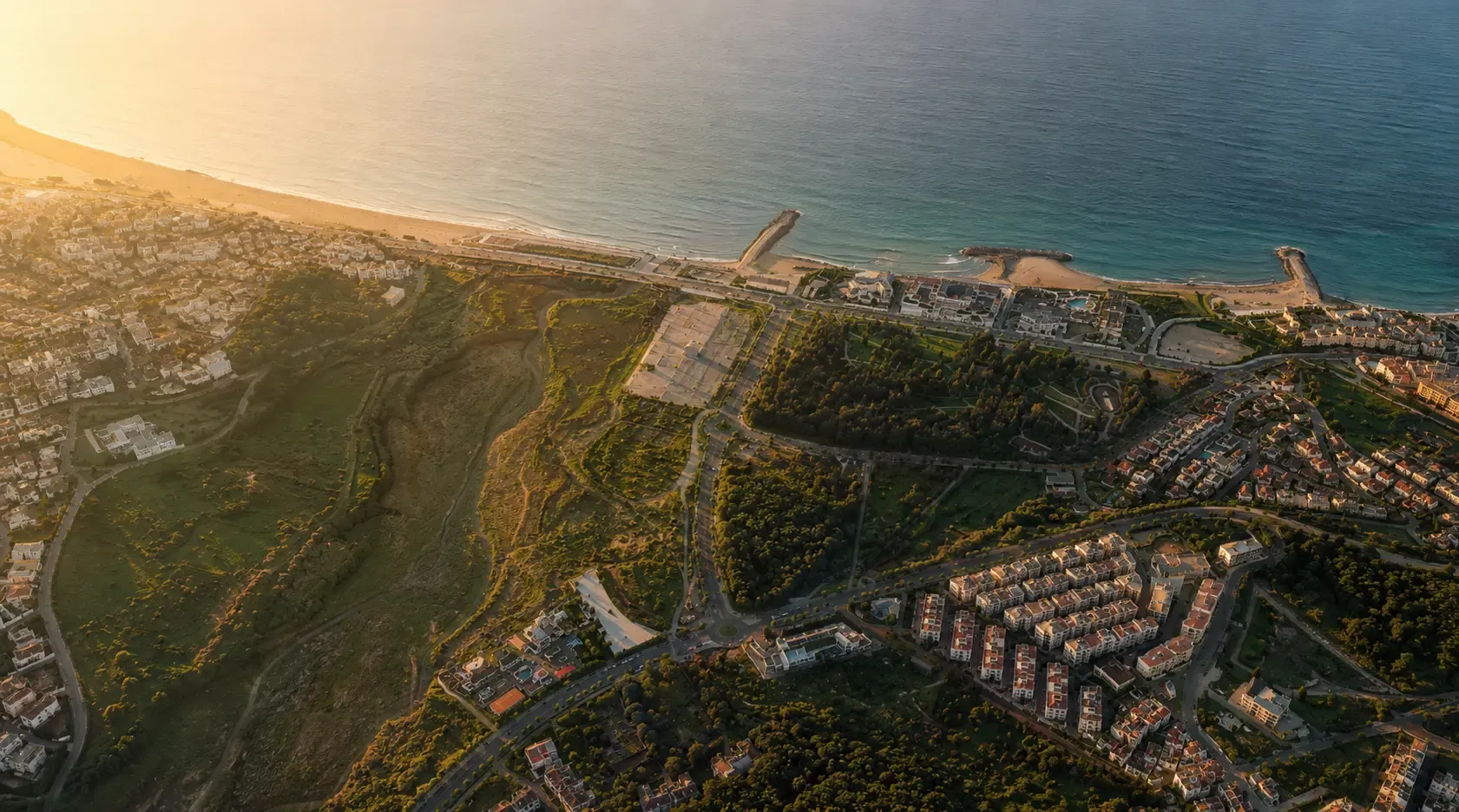
Property prices in Tangier's Touristic Zone—the tourism-zoned coastal corridor spanning Malabata, Ghandouri, and Achakar neighborhoods—rose from roughly 18,000 MAD per square meter in 2020 to approximately 45,000 MAD/m² by 2026, an increase of more than 150% in six years reflecting strong international investor interest. These three districts collectively represent the city's most coveted addresses for lifestyle buyers and international investors seeking Mediterranean coastal living. Prices are projected to reach approximately 62,000 MAD/m² by 2029–2030, suggesting continued appreciation from current levels but at a moderating pace. Eagle Hills Morocco, backed by Emaar's expertise, is developing master-planned communities in Malabata, introducing international-standard finishes and project management to the zone. The TGV high-speed rail connection made the zone commutable from Casablanca and Rabat for the first time, creating weekend and short-term resident demand distinct from tourism-only visitors. The steepest appreciation occurred between 2023–2026 (roughly 17–18% annually), with anticipated deceleration entering 2029–2030 as supply increases and prices normalize. This pricing trajectory suggests a 2–3 year remaining window for value-conscious international buyers before Tangier's undervaluation advantage closes relative to European Mediterranean alternatives. Current-entry buyers at 45,000 MAD/m² stand to capture 35–40% appreciation through 2030, attractive returns for patient, diversified investors.
What Is Tangier's Touristic Zone?
Touristic Zone is the official tourism-zoning designation covering Tangier's premier coastal development corridor — land specifically earmarked for hotels, resorts, marinas, and leisure-oriented residential projects rather than standard urban housing. It isn't one neighborhood but a designation that spans several of the city's most sought-after districts, including Malabata, Ghandouri, and Achakar.
Land inside this zoning carries stricter development standards than ordinary residential plots — minimum green-space ratios, height and density rules geared toward hospitality use, and infrastructure requirements tied to tourism traffic rather than everyday commuting. That stricter standard is part of why it commands a premium over comparable land just outside its boundaries: buyers aren't only paying for the location, they're paying for a guarantee that the surrounding development will stay coherent with a resort-grade neighborhood rather than drift toward denser, lower-cost residential building.
The Price Trend, Year by Year
Based on Immoworld's internal tracking of listings and closed sales across the zone, average asking prices per square meter have moved as follows:
- 2020: approximately 18,000 MAD/m²
- 2022: approximately 23,500 MAD/m²
- 2024: approximately 32,000 MAD/m²
- 2026: approximately 45,000 MAD/m²
- 2028 (projected): approximately 58,000 MAD/m²
- 2029 (projected): approximately 61,000 MAD/m²
- 2030 (projected): approximately 62,000 MAD/m², before growth picks back up and moves toward 70,000 MAD/m² beyond 2030
The steepest years of appreciation were 2023 through 2026, when the pace of new hotel and marina-adjacent development accelerated sharply. That's the period the curve climbs fastest — roughly doubling in three years — before the projected trend line begins to level off. For context, these figures track well above the citywide apartment average for Tangier as a whole, which reflects exactly what the zoning is designed to do: concentrate the fastest-appreciating, most tightly controlled development in one coastal corridor rather than spreading it evenly across the city — a pattern consistent with the wider trends covered in our 2026 Tangier market outlook.
What's Driving the Rise
Three forces explain most of this trajectory. First, the TGV high-speed rail connection made the zone realistically commutable from Casablanca and Rabat for the first time, pulling in a new pool of second-home and investment buyers who previously wouldn't have considered a coastal purchase this far north. Second, Tanger Med Port's continued expansion has driven broader economic growth across the city, with the coastal tourism corridor capturing an outsized share of the resulting demand — port-driven job creation tends to concentrate spending power in exactly the kind of buyers who then look for premium residential addresses. Third, the zone's own tourism-specific development — new hotel brands, marina expansions, and leisure infrastructure, including large-scale master-planned communities like Eagle Hills Morocco's projects in Malabata — has directly increased the value of the residential land sitting alongside it, since buyers are paying not just for their own unit but for the amenity base being built around it.
These three drivers reinforce each other rather than acting independently. Better rail access brings more visitors and residents, which justifies more hotel and marina investment, which in turn makes the zone a more attractive address for buyers who never intend to stay in a hotel at all — they simply want to live somewhere with that level of amenity nearby.
What Happens After 2026: The Projected Plateau
The projected slowdown after 2026 doesn't mean falling prices — it means the zone entering a more mature phase. Growth is expected to ease further into 2029–2030 specifically, as the current wave of hotel and marina-adjacent projects reaches completion, before picking back up again once the next phase of development begins. Early-stage tourism zones typically see their fastest appreciation while infrastructure is still being built and while supply is genuinely scarce; as Malabata, Ghandouri, and Achakar approach a more built-out state through the late 2020s, that pattern of alternating surges and pauses is the expected shape of the curve, not a sign the zone has topped out.
This kind of stepped growth pattern is common in tourism-zoned coastal markets elsewhere in the Mediterranean and North Africa: a sharp early rise as the first wave of development lands, a pause while that supply gets absorbed and the next set of permits and projects lines up, then a second rise once new hotel brands or marina phases break ground. Nothing about the 2029–2030 plateau in the data suggests the zone has reached its ceiling — it looks like the pause between two growth phases, not the end of one.
Which Part of the Touristic Zone Offers the Best Value Right Now
The three districts inside the zone aren't interchangeable, and where you buy matters as much as when. Malabata is the most established of the three, with the longest track record, the deepest inventory, and the closest proximity to the TGV station — it commands the highest prices per square meter but also the most liquidity if you ever need to resell. Ghandouri, home to its own tourism-zoned pocket around properties like the Idou Malabata Beach and Spa, sits a step behind Malabata on price while offering similar hospitality-grade infrastructure, making it a reasonable option for buyers priced out of Malabata's most established addresses. Achakar, further along the coast toward Cap Spartel, remains the most undervalued of the three relative to its setting — genuine tranquility and some of the most dramatic coastline in the area, at prices that haven't yet fully caught up to Malabata's.
For buyers optimizing purely for near-term appreciation, Achakar's relative discount makes it worth a closer look; for buyers prioritizing liquidity and an established track record, Malabata remains the safer, if pricier, choice. Buyers weighing Malabata specifically against the newer Marina Bay development just south of it should also see our dedicated Malabata vs Marina Bay comparison.
What This Means for Buyers and Investors
Buyers entering the Touristic Zone today are paying a real premium compared to 2020 prices, but they're also buying into a corridor with a much more established track record and infrastructure than it had six years ago — lower uncertainty, in exchange for a higher entry price. For investors specifically weighing timing, the historical pattern suggests the sharpest relative gains have already happened; the case for buying now rests more on the zone's fundamentals — location, tourism demand, limited remaining zoned land — than on expecting a repeat of the 2023–2026 growth rate.
The 2029–2030 stabilization is also worth factoring into timing decisions directly: buyers who can move before that plateau fully sets in are entering ahead of the next growth phase rather than during a pause, while those comfortable holding for the medium term may find the plateau years themselves offer more negotiating room on price than the market has had since 2020. Whatever the timing, budget for closing costs alongside the purchase price itself — our notary fee calculator gives an instant estimate for any property in the zone.
If you're considering a purchase in Tangier's Touristic Zone, browse current listings across Malabata, Ghandouri, and Achakar, or get in touch with our team to weigh the tradeoffs specific to each area.